
Three Immediate Actions Congress Must Take to Protect Farmers — and Why VYFA Is Stepping In

America’s farmers are being asked to survive unprecedented economic pressure without the federal support systems designed to protect them. As Congress advances continuing resolutions and delays a new Farm Bill, critical farm aid has been left out, creating real and immediate consequences for farm families, rural economies, and food security.
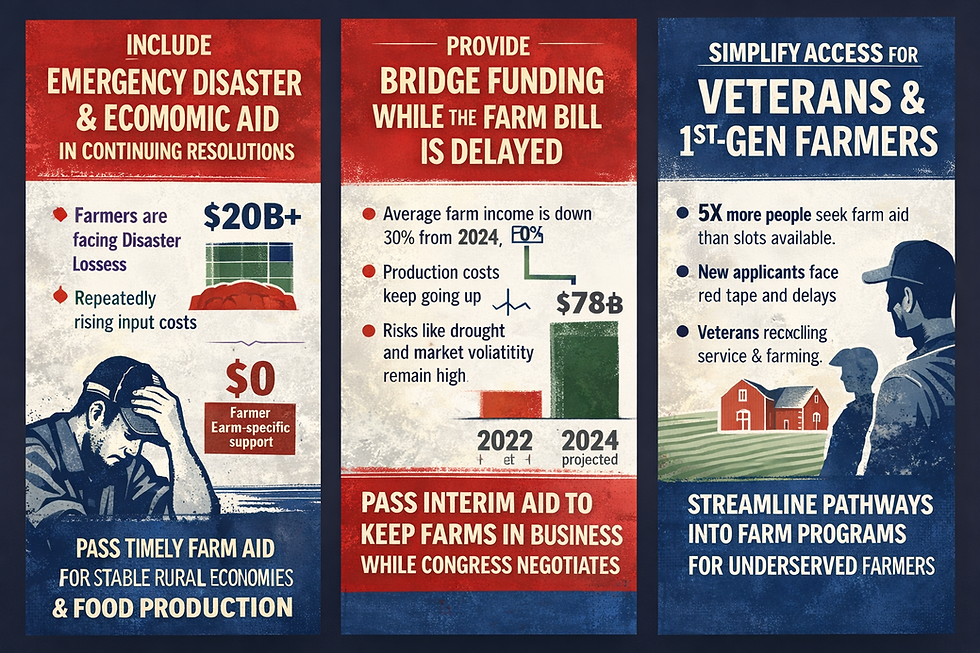
This moment demands action on three fronts — and it underscores why community-based nonprofits like the Veterans & Young Farmers Alliance (VYFA) are essential while federal policy stalls.
1. Emergency Disaster and Economic Aid Must Be Included in Continuing Resolutions
Farmers are facing repeated disasters — drought, floods, wildfires, extreme weather — while operating costs continue to climb. Yet recent federal funding bills excluded new disaster and economic assistance for farmers, despite clear evidence that losses are mounting.
According to Pro Farmer analysis reported by AgWeb, lawmakers moved forward with spending bills that provided no additional farm aid, even as farm income declines and disaster impacts accumulate. Without emergency assistance embedded in continuing resolutions, many farmers are forced to absorb losses alone, pushing more operations toward insolvency.
This omission is not a future risk — it is a present failure. Emergency aid is meant to stabilize production, protect land, and prevent cascading economic damage in rural communities. When it is delayed or denied, the fallout spreads far beyond individual farms.
2. Bridge Funding Is Essential While the Farm Bill Is Delayed
The United States is operating under outdated agricultural policy while Congress struggles to pass a new Farm Bill. Agricultural economists widely expect no comprehensive Farm Bill until at least 2026, leaving farmers without updated safety nets for multiple growing seasons.
During this gap, farm income has fallen sharply while production costs remain elevated. Industry groups have repeatedly warned that without interim support — often referred to as bridge funding — even well-managed farms may not survive the delay.
Bridge funding is not a luxury. It is a temporary lifeline that helps farmers:
Maintain operations
Manage market volatility
Cover rising input costs
Avoid permanent loss of farmland
Failing to provide interim aid effectively asks farmers to shoulder national food security risks on their own.
3. Access to Farm Programs Must Be Simplified for Veterans and First-Generation Farmers
Even when aid exists, access is not equal.
Veterans and first-generation farmers frequently face:
Complex application requirements
Limited program slots
Long processing delays
Lack of technical assistance navigating federal systems
As demand for farm assistance grows, available program capacity has not kept pace. New and transitioning farmers — particularly veterans — are often locked out not because they are ineligible, but because the system is too burdensome to navigate without support.
Simplifying access is not about lowering standards. It is about removing unnecessary barriers so qualified farmers can actually use the programs intended to help them succeed.
Where VYFA Comes In When Federal Action Falls Short
While Congress debates timelines and budgets, VYFA operates on the ground — filling gaps that federal policy currently leaves wide open.
VYFA focuses on:
Supporting veterans and young farmers navigating economic instability
Providing financial survival education and resource navigation
Advocating for practical, farmer-centered policy solutions
Amplifying real farm voices in policy discussions
Helping families stay on their land while federal aid is delayed or denied
VYFA does not replace federal responsibility — but it mitigates the damage caused when that responsibility is not met.
The Cost of Inaction Is Measured in Lost Farms
Without emergency aid, bridge funding, and simplified access:
Farms close permanently
Rural communities lose jobs and services
Food production consolidates further
Veterans transitioning into agriculture lose viable pathways
The next generation of farmers is pushed out before it can begin
Supporting organizations like VYFA is not charity — it is a strategic investment in resilience while national policy lags behind reality.
Conclusion: Action Cannot Wait
Congress has tools available right now:
Include farm aid in continuing resolutions
Pass bridge funding while the Farm Bill is delayed
Simplify access for veterans and first-generation farmers
Until those steps are taken, community-driven organizations like VYFA remain a critical line of defense for rural America.
Citations & Sources
AgWeb – Pro Farmer Analysis: No Farm Aid in Funding Billshttps://www.agweb.com/markets/pro-farmer-analysis/no-farm-aid-funding-bills
Agriculture.com – Proposed Government Funding Bills Don’t Include Farm Aidhttps://www.agriculture.com/partners-proposed-gov-t-funding-bills-don-t-include-farm-aid-e15-11890291
AgBull – Spending Bills Advance Without Farm Aid or Biofuel Add-Onshttps://www.agbull.com/shock-to-farm-bureau-spending-bills-advance-without-farm-aid-or-biofuel-add-ons
The Packer – Agricultural Economists Say Farm Bill May Not Pass Until 2026https://www.thepacker.com/news/education/59-ag-economists-think-congress-wont-pass-new-farm-bill-until-2026


Comments