
America's Foreclosure Crisis Is Growing — And Our Veterans Are Among Those at Risk

October 10, 2026
Veterans served to protect our country. Now, as mortgage distress rises across America, we must ask whether our country is doing enough to protect their homes.
Across the United States, more homeowners are falling behind on their mortgages, more properties are entering foreclosure, and more families are losing their homes.
For America's veterans, these numbers carry an especially troubling message.
These are men and women who served our nation, sacrificed time with their families, and, in many cases, returned home carrying physical, emotional, and financial burdens that can last a lifetime.
For many veterans, homeownership represents more than financial stability. It represents security, independence, and the opportunity to build a future after military service.
Yet the latest national housing statistics reveal that veterans with VA-backed mortgages are experiencing increasing financial distress.
At Veterans & Youth Farming Alliance (VYFA), we believe these warning signs deserve attention, transparency, and meaningful action.
Nationwide Foreclosures Are Increasing
According to ATTOM's August 2026 U.S. Foreclosure Market Report, foreclosure activity continues to rise across the country.
In August 2026 alone:
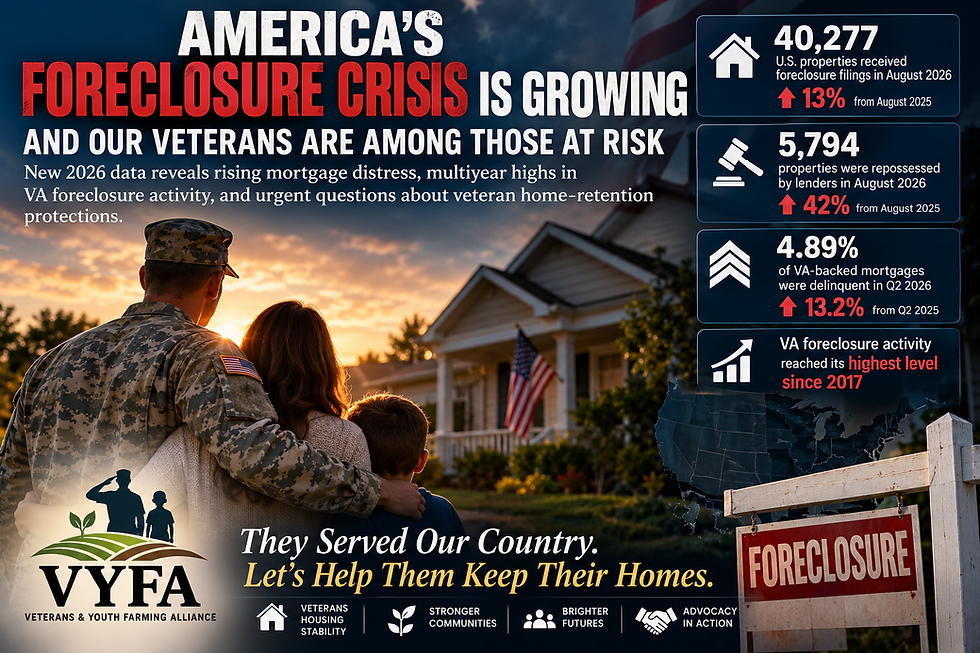
40,277 U.S. properties received foreclosure filings, a 13% increase compared with August 2025.
25,894 properties entered the foreclosure process, representing a 7% annual increase.
5,794 properties were repossessed by lenders, a 42% increase from the previous year.
Approximately one in every 3,569 U.S. housing units had a foreclosure filing during the month.
These statistics are particularly concerning because completed foreclosures represent properties that have already reached the lender-repossession stage.
Although national foreclosure activity remains below pre-pandemic levels, the year-over-year increases demonstrate that financial distress is growing.
Source: ATTOM, U.S. Foreclosure Rates by State — August 2026https://www.attomdata.com/news/most-recent/foreclosure-rates-by-state/
Veterans Are Not Immune to the Growing Housing Crisis
The Mortgage Bankers Association's second-quarter 2026 National Delinquency Survey revealed that 4.89% of VA-backed mortgages were delinquent.
That means approximately 4,890 out of every 100,000 outstanding VA-backed mortgages had at least one overdue payment.
The survey reported the following delinquency rates:
Mortgage Category | Delinquency Rate |
Conventional loans | 2.72% |
VA-backed loans | 4.89% |
FHA loans | 11.79% |
All mortgage loans | 4.37% |
Even more troubling, the VA mortgage delinquency rate increased by 0.57 percentage points compared with the second quarter of 2025.
This represents an approximate 13.2% relative increase in the VA delinquency rate over one year.
It is important to understand that delinquency does not automatically mean foreclosure. However, missed mortgage payments can be an early warning sign of financial instability, particularly when homeowners have limited options for resolving overdue balances.
Source: Mortgage Bankers Association, Mortgage Delinquencies Decrease Slightly in the Second Quarter of 2026, August 13, 2026.https://www.mba.org/news-and-research/newsroom/news/2026/08/13/mortgage-delinquencies-decrease-slightly-in-the-second-quarter-of-2026
VA Foreclosure Activity Reached Its Highest Level Since 2017
Perhaps one of the most concerning findings appeared in the Mortgage Bankers Association's first-quarter 2026 report.
According to MBA Vice President of Industry Analysis Marina Walsh, the VA foreclosure inventory rate reached its highest level since the second quarter of 2017.
That is a significant warning sign.
It means the share of outstanding VA-backed mortgages already in the foreclosure process had reached a level not seen in nearly nine years.
Meanwhile, the Federal Housing Finance Agency reported that 2.62% of VA loans were seriously delinquent during the second quarter of 2026.
Seriously delinquent mortgages generally include loans that are 90 or more days overdue or already in foreclosure.
For perspective, that represents approximately 2,620 seriously delinquent VA mortgages per 100,000 outstanding loans.
These figures do not mean that every seriously delinquent borrower will lose their home. They do, however, demonstrate why accessible and effective foreclosure-prevention programs are essential.
Sources:
Mortgage Bankers Association, Mortgage Delinquencies Increase in the First Quarter of 2026, May 14, 2026.https://www.mba.org/news-and-research/newsroom/news/2026/05/14/mortgage-delinquencies-increase-in-the-first-quarter-of-2026
Federal Housing Finance Agency, Foreclosure Prevention, Refinance, and FPM Report — Second Quarter 2026, September 24, 2026.https://www.fhfa.gov/reports/foreclosure-prevention-refinance-and-fpm/2026/Q2
Where Are Foreclosures Hitting Hardest?
The national foreclosure crisis is not limited to one region.
According to ATTOM, the states with the highest foreclosure filing rates during August 2026 included:
State | Housing Units per Foreclosure Filing |
South Carolina | 1 in 1,547 |
Nevada | 1 in 1,920 |
Florida | 1 in 2,397 |
Texas | 1 in 2,445 |
Maryland | 1 in 2,530 |
These statistics include all mortgage categories, not exclusively veteran-owned homes.
Nevertheless, they demonstrate the geographic reach of the country's increasing foreclosure activity.
Behind every foreclosure statistic is a household that may be struggling with lost income, unexpected expenses, medical costs, rising insurance premiums, or other financial challenges.
For veteran households, these difficulties can intersect with service-connected disabilities, changes in benefits, or the challenges of transitioning from military to civilian life.
Source: ATTOM, August 2026 U.S. Foreclosure Market Report.https://www.attomdata.com/news/most-recent/foreclosure-rates-by-state/
The VA Partial Claim Program: A Critical Foreclosure-Prevention Opportunity
On June 15, 2026, the Department of Veterans Affairs formally launched its new VA Partial Claim Program.
Authorized under the VA Home Loan Program Reform Act of 2025, the program was designed to help eligible veterans resolve mortgage arrears and remain in their homes.
Under the program, eligible borrowers may enter a three-month trial payment plan. Following successful completion and satisfaction of program requirements, overdue mortgage amounts may be addressed through a VA-backed partial claim.
The objective is to help qualifying veterans bring their mortgages current without immediately requiring repayment of the entire overdue balance.
However, implementation has not been instantaneous.
According to VA's October 1, 2026 servicer announcement, mortgage servicers have until November 28, 2026, to complete implementation of the VA Loss Mitigation Waterfall and Partial Claim Program.
This creates an important distinction between a program being officially effective and every mortgage servicer being fully prepared to administer it.
For veterans already behind on mortgage payments, time matters.
A veteran facing foreclosure cannot simply assume that every available relief option has been reviewed, offered, or implemented.
VYFA believes veterans deserve clear explanations of available programs, timely communication from their mortgage servicers, and fair consideration of applicable home-retention options.
Sources:
U.S. Department of Veterans Affairs, VA Launches Partial Claim Program to Help Veterans Avoid Home Foreclosure, June 15, 2026.https://news.va.gov/press-room/va-launches-partial-claim-program-to-help-veterans-avoid-home-foreclosure/
U.S. Department of Veterans Affairs, VA Partial Claims Program and Loss Mitigation Waterfall FAQs for Servicers.https://www.benefits.va.gov/HOMELOANS/partial-claims-servicer-faqs.asp
U.S. Department of Veterans Affairs, VALERI Servicer Newsflash, October 1, 2026.https://www.benefits.va.gov/HOMELOANS/servicers_valeri_news.asp
A Veteran's Home Should Not Become Another Casualty of Financial Hardship
The VA home loan benefit exists because our nation recognizes the sacrifices made by those who serve.
Yet the existence of a home loan guarantee does not eliminate the financial difficulties veterans may experience after purchasing a home.
A single missed payment can sometimes begin a chain of financial problems.
A delayed payment, unexpected medical expense, interruption in employment, or reduction in household income can create circumstances that become increasingly difficult to overcome.
When mortgage servicers, government agencies, and homeowners cannot resolve these difficulties quickly, the consequences can become devastating.
Families may face the loss of their homes, damage to their financial stability, and uncertainty about where they will live.
VYFA believes foreclosure prevention should prioritize sustainable solutions whenever possible, particularly when a homeowner demonstrates the willingness and financial ability to resume affordable payments.
We also believe veterans should receive accurate information about the programs designed to protect them.
What Veterans Facing Mortgage Hardship Should Know
Veterans experiencing mortgage difficulties should not wait until a foreclosure sale is scheduled to seek assistance.
Homeowners with VA-backed mortgages can contact their mortgage servicer to request a review of available home-retention options, including repayment plans, loan modifications, and the VA Partial Claim Program where applicable.
Veterans should also maintain copies of payment records, hardship correspondence, loss-mitigation applications, and communications with their mortgage servicers.
If a veteran is having difficulty resolving an issue with their mortgage company, the Department of Veterans Affairs provides additional assistance through its Loan Guaranty program.
VA Home Loan Assistance: 877-827-3702, Option 6
Eligibility for particular programs depends on individual loan circumstances and applicable VA requirements. Not every homeowner will qualify for every available option.
VYFA's Call for Accountability and Action
At Veterans & Youth Farming Alliance, we believe that protecting veteran housing stability is part of honoring the commitment our nation has made to those who served.
The statistics presented in this report are not merely percentages.
They represent households facing difficult decisions, families experiencing financial uncertainty, and veterans who may be struggling to preserve the homes they worked to obtain.
We believe the response should include greater transparency in mortgage servicing, effective implementation of foreclosure-prevention programs, accessible financial education, and meaningful assistance for homeowners experiencing temporary hardship.
We also believe the public deserves better reporting on veteran housing instability, including how many VA-backed borrowers enter foreclosure, how many receive successful assistance, and how many ultimately lose their homes.
Without accurate, accessible information, it becomes more difficult to evaluate whether foreclosure-prevention programs are reaching the people they were created to serve.
Our veterans should not have to navigate the threat of homelessness without clear information, fair treatment, and meaningful opportunities to preserve their housing.
The Bottom Line: Behind Every Number Is a Family
In August 2026, more than 40,000 properties across America received foreclosure filings.
Thousands more were repossessed by lenders.
VA-backed mortgage delinquency rates remain elevated compared with the previous year, and VA foreclosure activity has reached levels not seen since 2017.
These are warning signs that deserve national attention.
Veterans have already fulfilled extraordinary obligations to our country.
Our responsibility now is to ensure that the programs established to assist them are accessible, effective, and administered with accountability.
Because serving our veterans should not end when their military service does.
Veterans & Youth Farming Alliance (VYFA)Supporting veterans, strengthening communities, and advocating for opportunities that build lasting stability.
Data and reporting note: Statistics reflect the latest identified national foreclosure and mortgage performance reports available as of October 10, 2026. General foreclosure statistics include all mortgage categories. VA-specific delinquency and foreclosure measurements apply to VA-backed mortgages and should not be interpreted as counts of all veteran-owned homes. Foreclosure filings, mortgage delinquencies, and completed lender repossessions are distinct measures.



Comments