
America’s Family Farms Are Worth Fighting For

Protecting Our Farmland, Modernizing the Farms We Have, and Creating a Path for the Next Generation
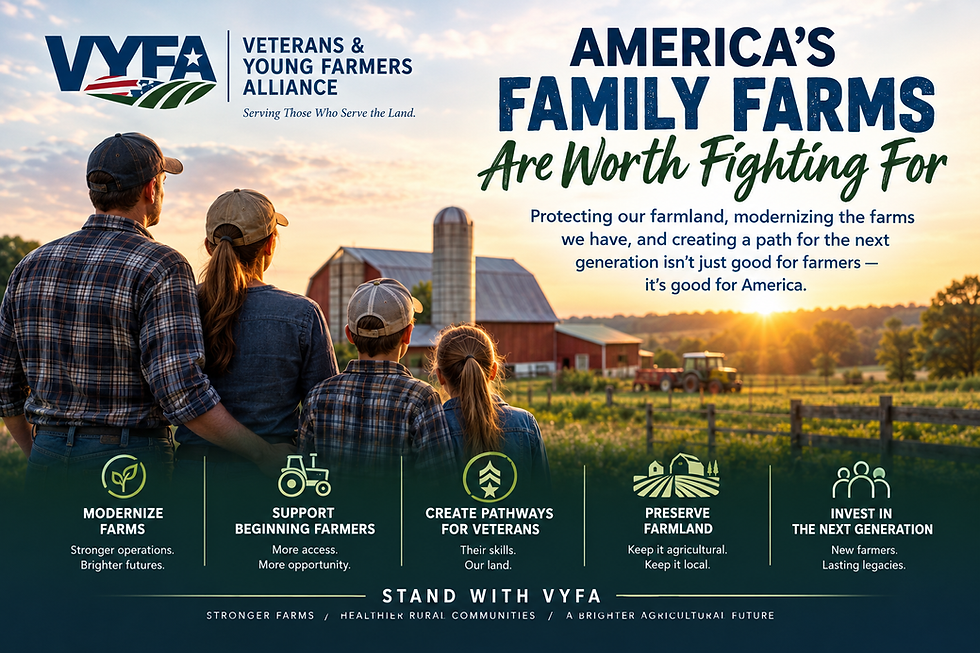
A fight is unfolding across rural America that deserves our full attention. It is a fight over who will own America's farmland, who will have the opportunity to farm it, and whether the next generation of American farmers will have a place to begin.
A recent Grist report, “As family farms decline and the climate heats up,” farmers weigh what to do with their land,” highlights some of the pressures facing American farmers as land values rise, farmers age, climate conditions change, and decisions about the future of farmland become increasingly difficult. In Michigan, for example, the amount of farmland where most operations were family-owned declined by nearly 470,000 acres between 2017 and 2022.
This isn't just a Michigan issue. It is an American issue.
According to USDA's National Institute of Food and Agriculture, more than 90 percent of U.S. farms are classified as small, and most are family-owned and operated. USDA identifies farm consolidation, an aging farm population, development pressures, and changing weather patterns among the challenges facing small and family farms. USDA also recognizes that these farms are important to rural economies and provide a starting point for new agricultural enterprises.
These farms matter. And the people who want to take them into the next generation matter.
We Cannot Afford to Lose the Family Farm
America cannot create more farmland.
Once productive agricultural land is permanently converted to development, bringing it back into production can be extremely difficult. At the same time, farmers are facing rising costs, changing markets, aging infrastructure, climate challenges, and difficult succession decisions.
USDA's Economic Research Service has specifically identified the aging farmer population, increasing concentration of farmland ownership, credit constraints, and competition for land as factors that can make it harder for beginning farmers to gain access to land.
That means we need to start asking a bigger question.
Not simply:
“What is this farmland worth?”
But:
“Who will be able to farm it in the future?”
This Is Not About Being Against Large Farms
VYFA is not against successful large farms, and this is not an argument that every large agricultural operation is a problem.
America needs productive agriculture at every scale.
But we should be concerned when continued consolidation makes it increasingly difficult for independent family farmers, beginning farmers, and new agricultural entrepreneurs to gain access to land.
There must be room for the family farm.
There must be room for the farmer who wants to operate 40, 80, 160, or 300 acres.
There must be room for the young farmer who wants to build something of their own.
There must be room for the veteran who wants to turn their skills and experience into agricultural ownership.
And there must be room for the existing dairy or livestock farmer who needs help modernizing instead of being forced to sell.
We Need to Modernize Farms Before We Lose Them
This is one of the most important parts of VYFA's mission.
We don't believe the answer is simply telling struggling farmers to hold on.
We need to help them become stronger.
That means modernization.
A small or mid-sized farm should not automatically have to disappear because its equipment is outdated, its infrastructure is aging, its technology is behind the times, or its business systems need improvement.
Modernization can mean better equipment, improved dairy facilities, water efficiency, energy improvements, livestock infrastructure, precision agriculture, better recordkeeping, improved financial management, stronger risk management, and better planning.
It can also mean helping farmers understand what improvements will actually strengthen their operation before they take on additional debt.
We should modernize the family farm before we replace the family farm.
That is the philosophy behind VYFA's modernization advocacy.
VYFA Is Advocating for a National Farm Readiness & Modernization Standard
VYFA is advocating for the National Farm Readiness & Modernization Standard, or NFRMS.
NFRMS is a proposed framework designed around a simple idea:
Before we decide that a farm is no longer viable, we should determine what could be done to make it viable.
We believe farms should have the opportunity to assess their equipment, infrastructure, technology, safety, financial management, production systems, risk management, and succession needs.
The goal isn't to give every farm the same solution.
The goal is to identify what each farm needs to remain productive, competitive, and prepared for the future.
That is advocacy.
It is also activism.
VYFA is not simply discussing the decline of family farms. We are advocating for changes that could help prevent farms from reaching the point where selling becomes the only option.
Modernization Is Part of Farmland Preservation
Farmland preservation cannot simply mean keeping land out of development.
We also have to keep the farm itself economically viable.
A farm can remain agricultural land on paper and still disappear as a family business if the farmer can no longer make a living.
That is why VYFA believes farmland preservation and farm modernization must go together.
USDA NIFA specifically identifies whole-farm planning, farm transition planning, risk management, improved agricultural practices, technology, and profitability as important areas for supporting small and family farms.
We agree.
Protect the land. Strengthen the farm. Support the farmer. Prepare the next generation.
We Need a Path for the Next Farmer
Protecting today's farms is only half the job.
We also need to make sure there is someone prepared and able to take over tomorrow.
Beginning farmers face real barriers. USDA reports that beginning farmers often operate smaller farms and have less wealth and more limited access to capital than established farmers. USDA also identifies access to farmland and startup costs as significant challenges.
This is especially important when we talk about farm succession.
Not every farmer has a child who wants to take over.
Not every child who wants to farm can afford to buy the family operation.
Some farms have multiple heirs. Some families need new succession arrangements. Some farmers are ready to retire but have no clear successor.
Meanwhile, there are people who desperately want to farm but cannot find a realistic pathway to ownership.
We need to connect those two realities.
Veterans Should Have a Place in American Agriculture
VYFA believes veterans can be an important part of America's agricultural future.
Veterans bring experience in leadership, logistics, planning, operations, maintenance, accountability, teamwork, and problem-solving. Those skills can translate well into farm management.
But experience alone doesn't put a farmer on the land.
A veteran who wants to become a farm owner needs access to land, financing, education, management preparation, technical assistance, and a realistic pathway to ownership.
The same is true for young and beginning farmers.
We should not simply tell people to become farmers. We should help create a path that makes ownership possible.
We Need to Stand Up Against a Future With Fewer and Fewer Owners
Again, VYFA is not calling for the elimination of large farms.
We are calling for balance.
We should be able to have successful large agricultural operations while also protecting opportunities for small and mid-sized family farms.
We should be able to modernize agriculture without making it impossible for new farmers to enter.
We should be able to embrace technology without abandoning the farmer who cannot afford the latest equipment without assistance.
And we should be able to grow American agriculture without allowing consolidation to eliminate the opportunity for independent ownership.
Growth should create opportunity, not eliminate it.
This Is Where Advocacy Becomes Action
VYFA is advocating for agricultural modernization, farm readiness, land access, succession planning, and opportunities for veterans and beginning farmers.
But organizations cannot do this work alone.
Farmers need to speak up.
Consumers need to speak up.
Rural communities need to speak up.
And citizens need to speak up.
You don't have to be a farmer to care about what happens to American farmland.
You can start in your own state.
Find out what is happening to farmland where you live. Find out whether farms are being lost to development or consolidation. Learn what programs your state offers to beginning farmers and what resources exist for farm modernization.
Contact your state senator and state representative.
Ask them what they are doing to keep small and mid-sized farms economically viable.
Ask what they are doing to help beginning farmers and veterans gain access to land.
Ask whether your state has a meaningful strategy for farm modernization.
And ask what is being done to help retiring farmers transition their land to the next generation.
Then show up.
Attend public meetings. Go to agricultural hearings. Pay attention to local land-use decisions. Support local farmers. Buy directly from farms when you can. Share their stories. Let your elected officials know that working farmland and family farms matter to you.
You don't have to change the entire agricultural system tomorrow.
Start where you live.
Ask a Different Question
When a family farm is struggling, we shouldn't immediately ask:
“When will they sell?”
We should ask:
“What would it take to help them stay?”
Could the farm be modernized?
Could the equipment be upgraded?
Could infrastructure be improved?
Could better management systems increase profitability?
Could the farm transition to the next generation?
Could a beginning farmer take over?
Could a veteran become the next owner?
Could the farm remain productive for another generation?
Those are the questions VYFA believes America should be asking.
The Future of American Agriculture Is Being Decided Now
The future of American agriculture isn't something that will be decided 50 years from now.
It is being decided today — through land sales, development decisions, farm succession, agricultural policy, investment, modernization, and the choices we make about who gets the opportunity to farm.
We cannot simply wait until the family farm disappears and then decide that we should have done something.
By then, it may be too late.
The USDA has already identified the challenges facing small and family farms. The data shows that beginning farmers face significant barriers to land and capital. The Grist report demonstrates the difficult choices farmers are already facing as they consider what will happen to their land.
Now we need action.
Stand With America's Family Farms
VYFA believes America should protect its farmland, strengthen the farms already operating on it, and create opportunities for the people who want to farm tomorrow.
That means modernization.
It means succession planning.
It means land access.
It means supporting beginning farmers.
It means creating pathways for veterans to become agricultural owners.
It means standing up for small and mid-sized farms.
And it means making sure agricultural progress does not come at the expense
of agricultural opportunity.
We should modernize the family farm before we replace it.
We should protect farmland before it is gone.
We should create opportunities for new farmers before there are no farms left for them to inherit or buy.
And we should never accept the disappearance of the American family farm as inevitable.
The land is our agricultural inheritance.
The farmers are its stewards.
And the next generation deserves a chance to inherit both.
Stand With America's Family Farms.
Stand for Agricultural Modernization.
Stand for Farmland.
Stand for the Next Generation.
Stand With VYFA.
Sources & Further Reading
Grist, “As family farms decline and the climate heats up, farmers weigh what to do with their land.” Read the Grist article
USDA Economic Research Service, Access to Farmland by Beginning and Socially Disadvantaged Farmers: Issues and Opportunities. Read the USDA ERS report
USDA National Institute of Food and Agriculture, Small and Family Farms. Read the USDA NIFA resource
USDA Economic Research Service, Farmland Ownership and Tenure. Read the USDA ERS resource


Comments